


Grand Portage National Monument & Grand Portage National Monument Heritage Center
Discover the fur trade era and the rich heritage of the Ojibwe people at the Grand Portage
National Monument, a restored North West Company Depot.
Kitchi Onigaming, "the Great Carrying Place" or Grand Portage, became the main entry point
of European trade with Native peoples, connecting the headquarters and western supply depot
of the fur trade on Lake Superior to smaller posts located on the Pigeon River. From there the
posts linked to North American exploration, trade and commerce. To efficiently move cargo,
successful traders adopted Native tools, implements and traveling methods: birch bark canoes,
snowshoes, toboggans and sled dogs.
At the Monument, the stockade wall, great hall and kitchen complex have been reconstructed
over the original archaeological footprint from the late 18th century. A canoe warehouse
features vessels crafted from birch, cedar and spruce raw materials, which were so essential for
travel along the east-west fur trade routes. Volunteers and park staff in period attire explain and
interpret what life was like at the turn of the 19th century.
Designated a National Monument in 1958 and added to the National Register of Historic Places
in 1966, the Monument’s 710 acres lie entirely within the boundaries of Grand Portage Ojibwe
Indian Reservation.
Grand Portage National Monument also has two hiking trails: The Mount Rose trail and the
Grand Portage trail. For more information on these and other hiking trails in the area visit our
Hiking Trails page.
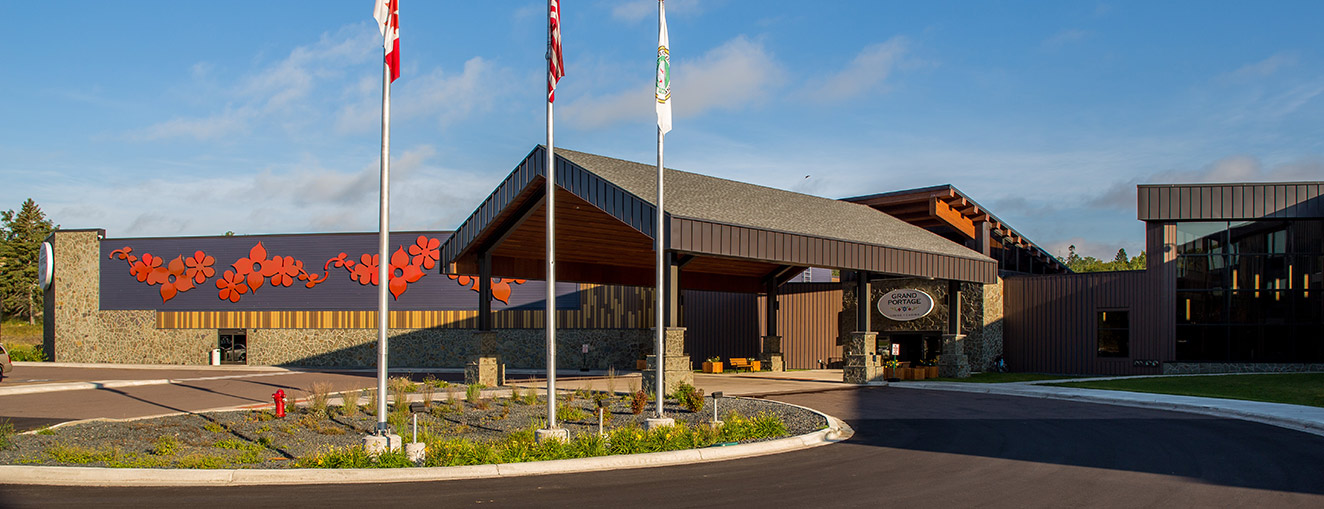
The Grand Portage National Monument’s Heritage Center is open year round and features
exhibit galleries, a gift shop and visitor information. For more information call 218-475-0123 or
visit online at www.nps.gov/grpo or www.nps.gov/grpo/pphtml/kids.html.
|
|